
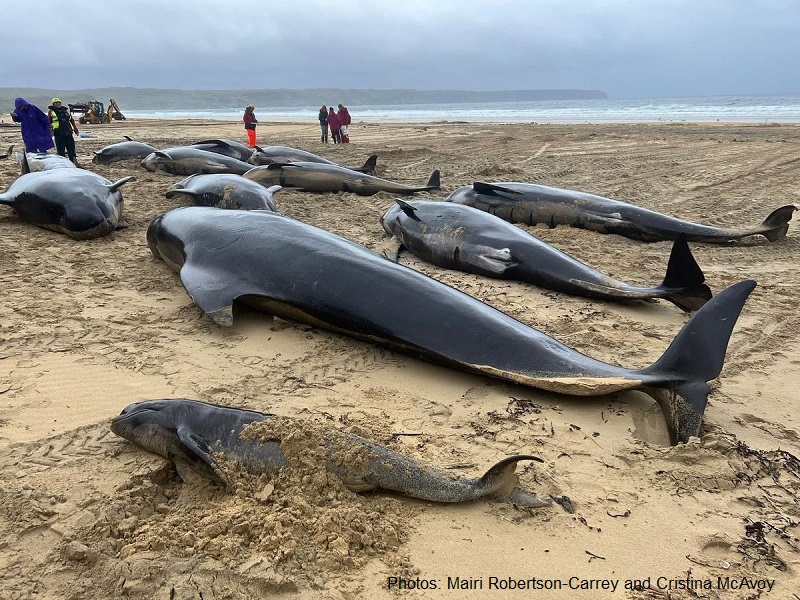
Civil Air Support were alerted to the mass stranding of a pod of 55 pilot whales near Stornoway on Sunday morning. British Divers Marine Life Rescue (BDMLR) mobilised specialist Marine Mammal Medics with the skills and equipment needed to assist local experts already at the scene, but the logistics of getting them from their mainland bases to the site of the stranding were complex and challenging.
Recognising the urgency of the situation, a twin-engine Cessna 414 of the Civil Air Support fleet departed Turweston at 10:45, collecting a BDMLR Medic and equipment in Newcastle and Dundee before departing on its final leg towards the Isle of Lewis.
Sadly, the rescue party realised the race against time was lost when news reached the aircraft that almost all the pilot whales had died, as it approached Loch Ness just 90 miles short of Stornoway. Civil Air Support pilot Graham Mountford who had kindly donated his time and aircraft for this mission had no alternative other than to return to Turweston via Newcastle.
Adult long-finned pilot whales can grow up to 2,300 kg and reach a body length of up to 6.5 metres making them extremely difficult to rescue once they become stranded. With communications limited on the Isle of Lewis and the location difficult for emergency responders to reach, the probability of a successful rescue was always slight. Despite their best efforts, BDMLR were ultimately able to refloat only 1 of the pilot whales.
Whilst tragic, the stranding of whole pods of pilot whales is not an entirely uncommon phenomenon. They are a particularly social species and stay together as a group with offspring remaining in their mother’s pod for a lifetime. It’s known that strandings sometimes occur when one whale is injured and becomes beached, and the remainder of the pod stay close to provide protection and support. This is thought to have been the case in Stornoway as one of the female cetaceans is known to have suffered a prolapsed vagina. An extremely distressing event in any case, this almost human tendency to support a family member in need with which we can all identify adds a deeper layer of sadness.
CAS would like to extend our thanks to all who participated in supporting the mission including ground staff and handling agents at Turweston Aerodrome, Newcastle Airport and Dundee Airport. The charity is only able to function because its crews donate their time and aircraft free of charge, and with the support of those airports and associated providers who waive fees and charges for our humanitarian flights.
 Civil Air Support